
EXTENSIVE PROFESSIONAL AND SECTOR-SPECIFIC EXPERTISE
Close links with the Procurement Conference, its high-profile Advisory Board and the relevant specialist communities.
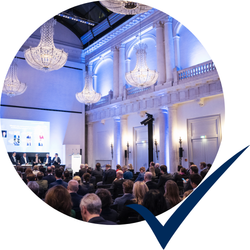
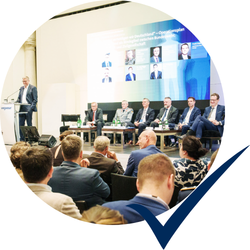
HIGH VISIBILITY IN THE RELEVANT FIELD
Visible involvement of study partners in communication, the presentation of results and professional dialogue.

HIGHEST QUALITY & DATA SECURITY
A scientifically sound approach, data collection in compliance with data protection regulations, and professional statistical analysis.
PRECISE ANALYSES & PRACTICAL INSIGHTS
Scientifically sound analyses with specific recommendations for action for policymakers, public authorities, procurement departments and technology providers.
Key themes of the study
01 Reducing bureaucracy & speeding up processes
Where do complex regulations and processes slow down public procurement?
02 Digitalisation & AI
Where can digital solutions and AI simplify processes and make procurement more efficient?
03 Competition & Market Access
What is needed to make it easier for companies, SMEs and innovative suppliers to participate in the public market?
04 Capacity to Act & Resilience
How must procurement be structured to be able to respond quickly and reliably, even in times of crisis?
05 Sovereignty & strategic procurement
How can procurement reduce dependencies and strengthen security of supply?
Study design


Oliver Lorenz
Managing Partner und CEO
Wegweiser Media & Conferences GmbH und Wegweiser Research & Strategy GmbH

Franziska Mehlhase
Senior Programmmanagerin - Strategische Geschäftsentwicklung, Analyse & Teamleitung
Wegweiser Research & Strategy GmbH
Dear partners and interested parties,
The brief study on the procurement conference highlights where public procurement is currently under the greatest pressure to change and which levers are crucial for greater capacity to act.&
To this end, it brings together the perspectives of the public sector, the business community and procurement practitioners, and provides up-to-date insights into key future topics such as reducing bureaucracy, digitalisation, AI and competition. In this way, the study creates a sound basis for discussion between decision-makers, solution providers and policymakers.
Yours sincerely,
Franziska Mehlhase